
Biodiversity in South Carolina: Where Commerce and Conservation Meet
Biodiversity is often defined simply as the variety of life on Earth. But as Sustain SC’s Senior Vice President of Conservation, Kristen Austin Gunter, shared in opening Sustain SC’s September 23 Biodiversity Workshop, that definition only tells part of the story.
In South Carolina, biodiversity is also the lived experience of place: the harbor at first light, wind through longleaf pine, the Blue Ridge Mountains, barrier islands along the coast and working lands that produce that which sustains us. It is part of what makes South Carolina home.
That perspective framed the workshop at the South Carolina Aquarium’s Boeing Learning Lab at the Charleston Maritime Center, where business and conservation leaders explored why biodiversity matters to South Carolina’s economy, how companies can incorporate it into operations and what greater alignment could look like across the state, including launching a Biodiversity Learning Network across South Carolina.
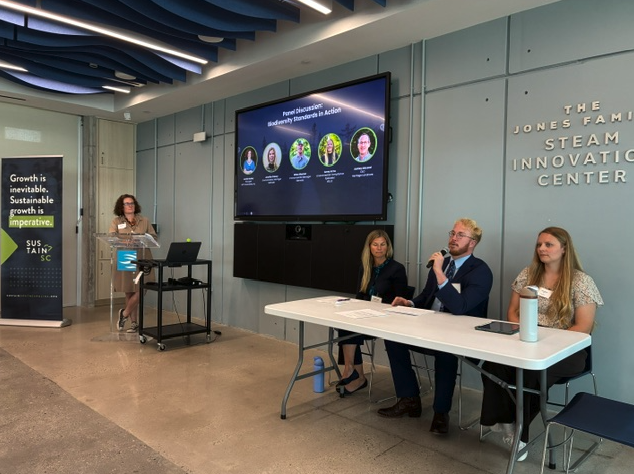
Speakers from the September 23 Biodiversity Workshop
South Carolina’s Economy Depends on Healthy Land and Water
South Carolina’s natural resources are deeply connected to its economy. Tourism reached a record $31 billion in economic impact in 2025 and supports roughly 1 in 10 jobs statewide. Agriculture and forestry together form agribusiness, the state’s largest economic sector, with an estimated $51.8 billion economic impact and more than 259,000 jobs.
Against the backdrop of South Carolina’s continued growth, protecting the land, water and natural systems that support those industries requires proactive planning. Anna Huckabee Smith, Director of Conservation Grants and Strategic Outreach for the South Carolina Department of Natural Resources, emphasized the value of diversity within natural systems. “Just because it’s green, doesn’t mean it’s good,” she said. “Uniformity is hazardous to biodiversity. "Her message was simple: healthy ecosystems, like strong investment portfolios, rely on representation, redundancy and resilience.
Alex Butler, Director of Resilience for the South Carolina Office of Resilience, reinforced the need to plan ahead. “Just because things have been a certain way doesn’t mean they will remain,” he said.
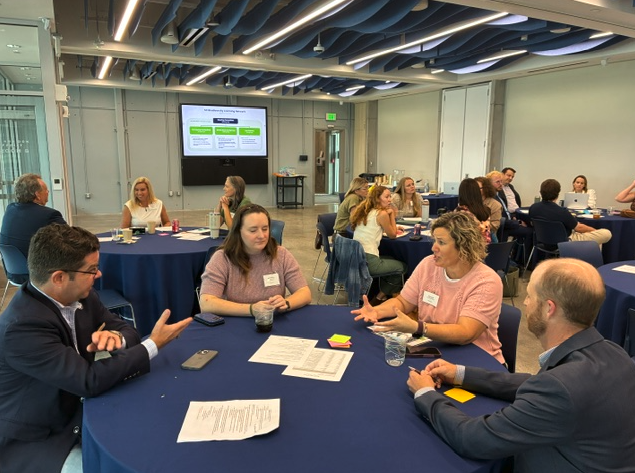
Attendees at the Biodiversity Workshop
Bringing Biodiversity into Business Strategy
For companies, biodiversity can be difficult to incorporate into resilience planning and achieving environmental and sustainability goals. Jackie Baxley, Principal and EHS&S Practice Leader for HRP Associates, provided an overview of common corporate sustainability frameworks and noted that biodiversity remains underrepresented in many of them. That gap can leave biodiversity out of a company’s materiality assessments and limit the role stakeholder input plays in identifying risk and developing and implementing mitigation strategies.
A panel featuring Jennifer Stacey, Environmental Manager for Michelin Americas-TZA, Brian Weaver, Environmental Manager for Siemens and Anna Arms, Environmental Compliance Specialist for VELUX,
showed what biodiversity standard implementation can look like at the site level.
Each company is approaching the work differently. Michelin has committed to eliminating pesticide use and developing site biodiversity management plans. Siemens is working toward conservation plans at every relevant site by 2030. VELUX is bringing global standards into U.S. operations through a biodiversity scorecard known as a “biowheel.”
The common thread: set measurable goals, understand your baseline and build a plan that works for the site.
Start Where You Are
Biodiversity expertise does not always exist in-house, and panelists emphasized that companies do not have to do the work alone. Employees can help identify opportunities and build support internally, while conservation organizations can bring technical knowledge companies may not have on staff.
Successful programs also require collaboration across departments and with external partners to develop plans that are both meaningful and realistic.
The advice for companies getting started was practical: establish a baseline, take small steps and build from there.
As one panelist put it: biodiversity work is a journey, not a destination. Get caught trying.
Aligning South Carolina’s Commerce and Conservation Efforts
The workshop also explored what greater alignment could look like at the state level.
Lisa Lord, Vice President of Operations for the Longleaf Alliance moderated a panel where John Quinn, PhD, Chair of Environmental Studies and Professor, Furman University, Trip Chavis, President and CEO, Milliken Advisors, George Chastain, Executive Director, Hobcaw Barony and The Belle W. Baruch Foundation, and Anna Huckabee Smith of SCDNR, identified three recurring needs: shared language, better data and the right incentives.
Industry, conservation organizations and public agencies may often be working toward similar outcomes while using different terminology. As a result, collaboration stalls before it ever gets started.
Beyond the shared language, accurate and accessible data are needed to create shared understanding. According to Anna Huckabee Smith, the state has strong maps, but what it needs now is ground truth. Creating shared language can make collaboration easier, while more accessible data can support better decisions.
Economic incentives matter too. George Chastain named incentives as key to unlocking a more sustainable South Carolina. Pointing to the loss of roughly 12 million tons of annual wood demand following mill closures in South Carolina, he shared that most timberland in this state belongs to families and small landowners who rely on income from that land to manage it well, so when the market for wood disappears, the ability to care for it becomes a challenge.
That makes the relationship between conservation and commerce especially important. Strong markets, better information and collaboration can help keep working lands both economically productive and ecologically valuable.
Developing a Biodiversity Learning Network for South Carolina
Sustain SC has a role to play in bringing those pieces together. Following presentations and panel discussions, participants helped refine a new concept: the Biodiversity Learning Network.
Developed with guidance from a steering committee of industry and conservation leaders, the Network will launch in early 2027 and bring stakeholders together through focused working groups. The goal is to advance biodiversity management across South Carolina through shared language, shared goals, stronger collaboration and practical incentives that help move programs forward.
Showing Up is Shaping South Carolina
Before the Biodiversity Learning Network launches, the connection continued at Sustain SC’s 5th Annual Sustainability Symposium held on October 22 at Central Energy in Columbia.
As the Symposium’s keynote speaker, Robert Bonnie, Founder of Sage Agronomics and former USDA Undersecretary for Natural Resources and Environment, presented The Economic and Conservation Power of South Carolina’s Working Lands, exploring how working lands can support conservation, strengthen South Carolina’s economy and sustain rural communities.
The Symposium is open to members and nonmembers and will bring together leaders from across business, conservation and government to build relationships, exchange ideas and strengthen the connections needed to move South Carolina forward.