
Reuse, Resilience and the Economic Equation of Circularity: Takeaways from Sustain SC’s 2026 Circularity Summit
On August 18, Sustain SC convened business leaders, recyclers, local government officials, state agency staff, academics and legislators at EdVenture Children's Museum in Columbia for the 2026 Circularity Summit.
The day was built around expanding our collective understanding of what a circular economy is, why it is critical for South Carolina to address and how we move forward as a state. This event convened the full ecosystem of stakeholders: the businesses recovering materials, the local governments delivering services, the agencies tracking the data and the researchers modeling what comes next.
The Summit opened with a tour of EdVenture's Fossils to Futures circularity exhibit, where a room full of professionals were invited to use their imaginations, to see circularity through a child’s eyes as a way to cut through the complexity. It closed with those same professionals working to apply their expertise and perspective to help define a statewide economy that keeps materials in use.
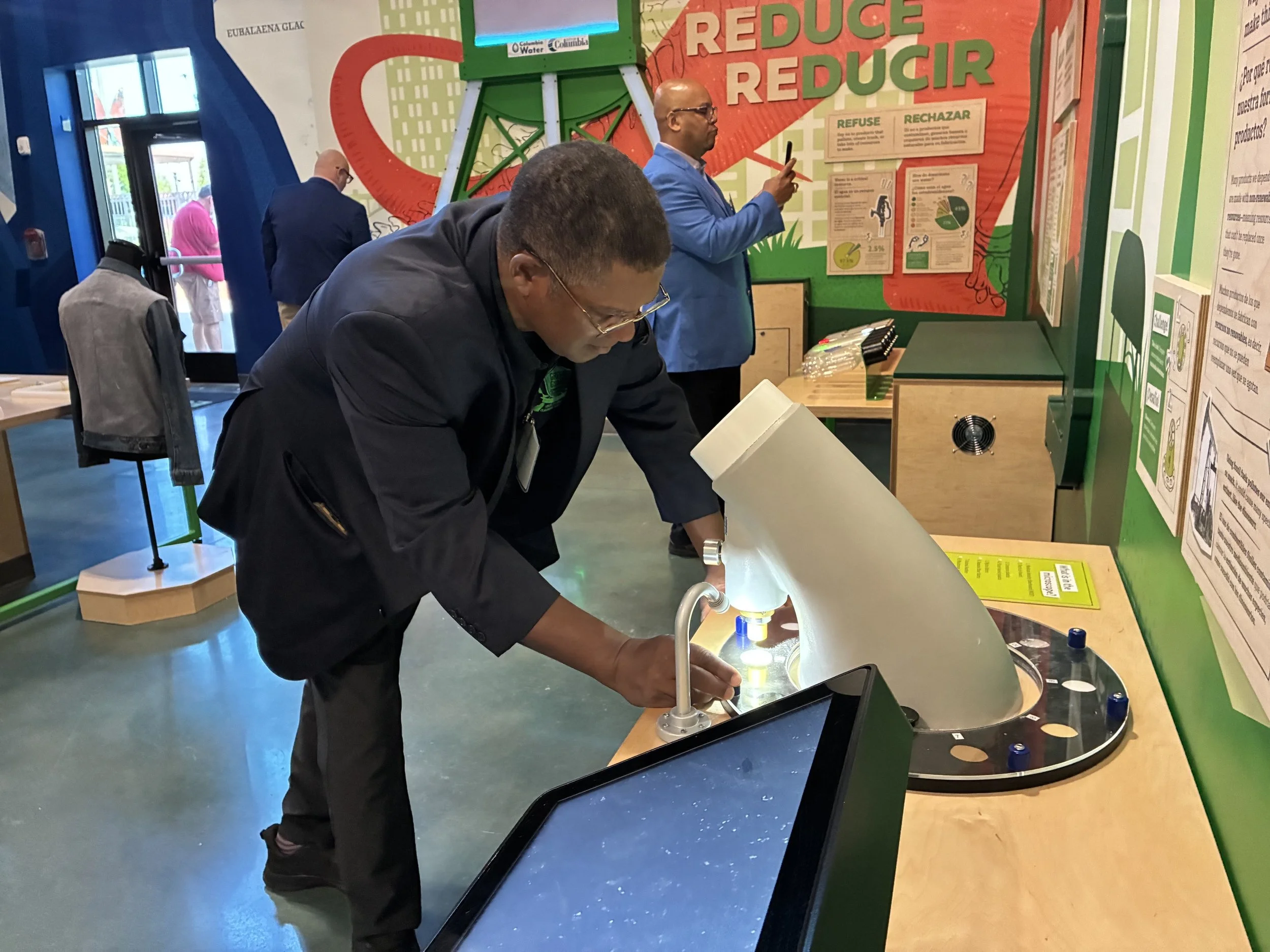
Throughout the event, the data, case studies and stakeholder input pointed in a consistent direction: continued conversation and collaborative problem solving is needed to grow a circular economy in South Carolina.
Lt. Governor Pamela Evette, a long-time advocate of litter prevention and recycling, opened the day-long discussion about circularity. Her realization came, she said, when she began looking at recycling beyond the curbside blue bin and began to think about it as a business imperative: “How do we get people to do business in South Carolina when we have litter on the freeway?” she asked. A large South Carolina manufacturer she said, in part chose South Carolina as home because they were looking for a state that took pride in the place they lived.
Lt. Gov. Evette’s framing of recycling as a business opportunity set the stage for the remainder of the day, particularly as we examined the state of recycling in South Carolina.
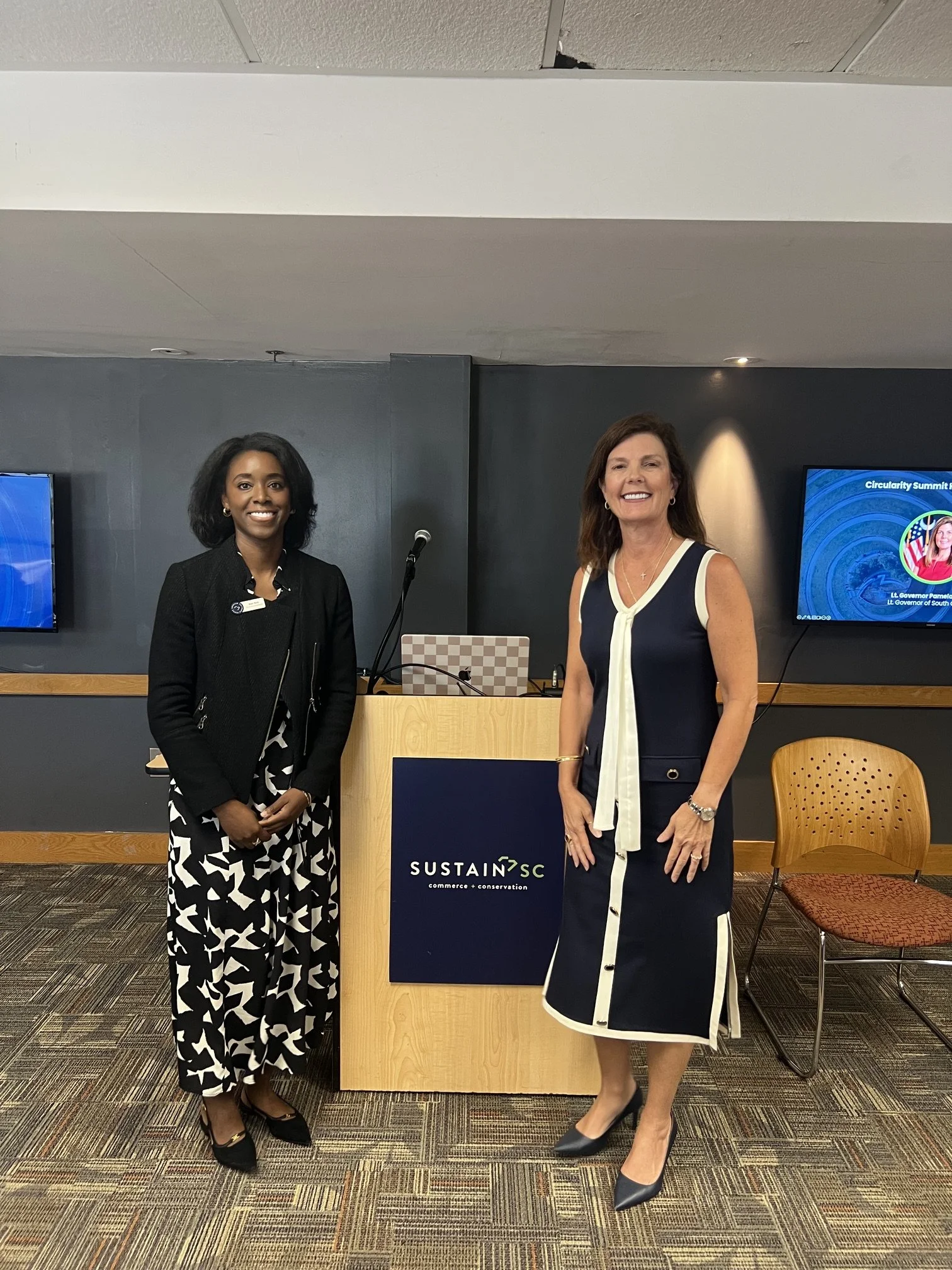
Blair Belk, Director of Government Relations for Coca-Cola Consolidated and Sustain SC Board Member with Lt. Governor Pamela Evette.
State of Recycling in South Carolina: Economics, Policies, Infrastructure and Education
Grace Anne Martin of the S.C. Department of Environmental Services presented the state's municipal solid waste characterization study, which found that 47.4 percent of what South Carolina sent to landfills could have been diverted:
Roughly 17.1 percent was material with established recycling markets, economic networks where collected waste materials are bought, sold and turned into new raw materials. That material consisted of cardboard, paper, metal cans, plastics and glass.
The state spent more than $27.1 million on tipping fees, the charge paid to drop off waste, on burial of recyclable material and forfeited an estimated $91.6 million in recycling revenue.
Local governments spent $524.6 million on solid waste management in fiscal 2025 while earning less than $2 million from the sale of recyclables.
Next, Adriana Diotalevi, Recycling Market Development Coordinator for the S.C. Department of Commerce, shared circularity’s economic impact. Over the last five years, the state has seen nearly $7 billion in capital investment in the recycling industry, creating 5,738 new jobs across 39 industries. While this impact is meaningful, the South Carolina Solid Waste Policy and Management Act of 1991 set an ambitious goal to make recycling an economic driver, not an environmental obligation. The 14-member, Governor-appointed Recycling Market Development Advisory Council (RMDAC) supports that mission, making annual recommendations to the Governor and the General Assembly informed by regional listening sessions. RMDAC continues to hear the same issues statewide:
Incentives, and the economics, favor disposal over recycling;
Infrastructure improvements are dire;
Education and awareness are critical; and
Policy reform is a prerequisite to progress.
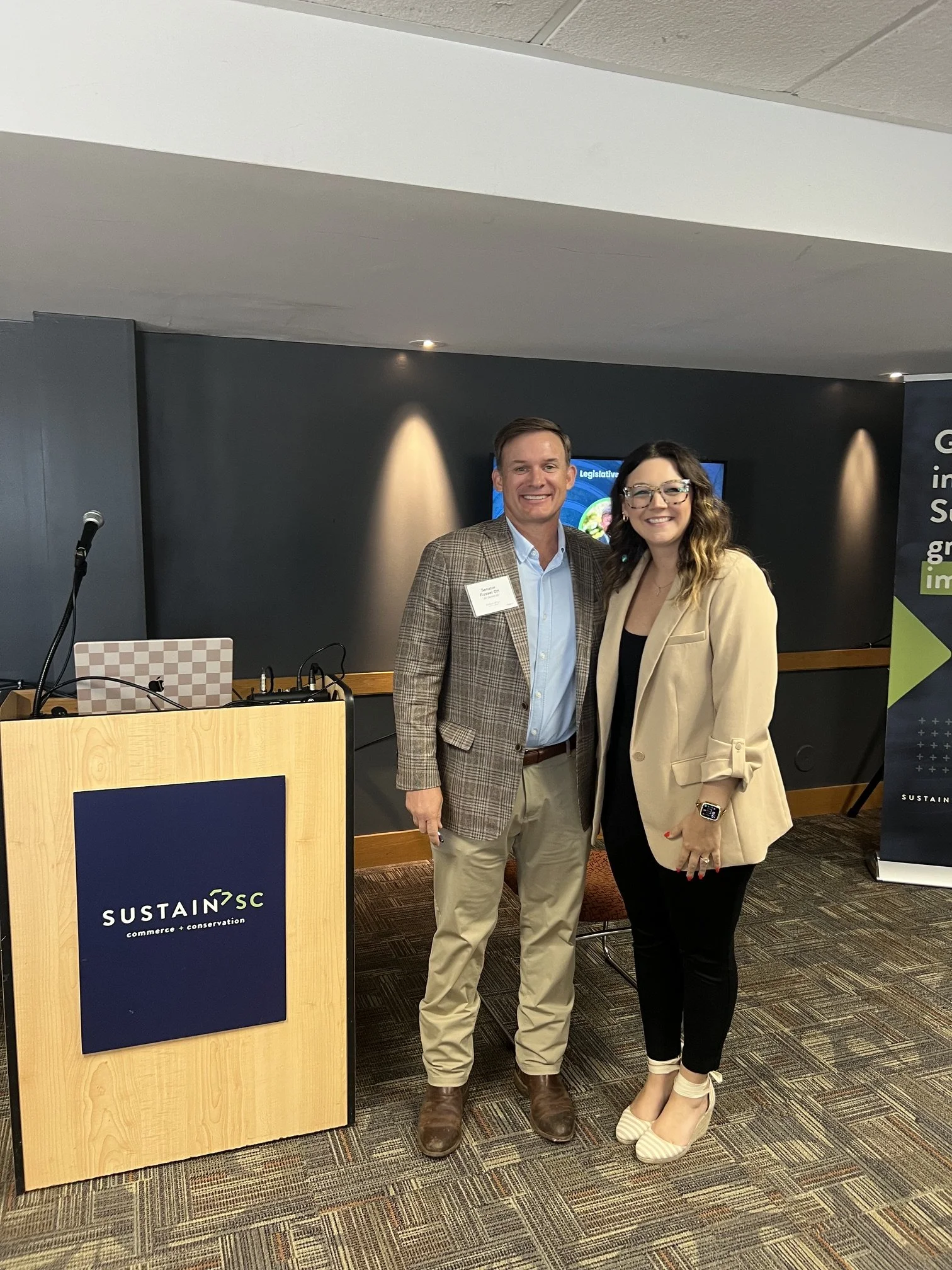
State Senator Russell Ott with Sustain SC’s Director of Sustainability, Emily Skaggs.
During his Legislative Update, State Senator Russell Ott acknowledged the prospective impacts South Carolina faces with projected growth. “The growth and impacts are not slowing down,” he said. “At the end of the day we have to figure out the funding mechanisms.” He noted that the General Assembly has a duty to equip communities with the solutions they need to advance circularity.
Building on presentations and comments from policy makers, Sustain SC facilitated a break-out activity to uncover the key messages that municipal, county and state government officials need to hear to advance circularity in South Carolina.
Beyond the Bin: Participants Ask for Consistency, Improved Coordination and Shared Standards
Participants workshopped ideas to improve the state’s circularity at local, county and state levels. Their recommendations spanned three levels of government and touched on consistent themes:
At the municipal level, priorities included consistent messaging, training and education.
At the county level, priorities included regulatory uniformity and best-practice sharing across counties.
At the state level, priorities included regulations, funding and public-private partnerships.
Circ-Talks: TED-style Presentations Highlight Cross-Sector Momentum
While policies, communications campaigns, education and partnerships take time, five recycling and waste leaders shared what they are doing today to advance circularity in South Carolina through brief presentations followed by discussion.
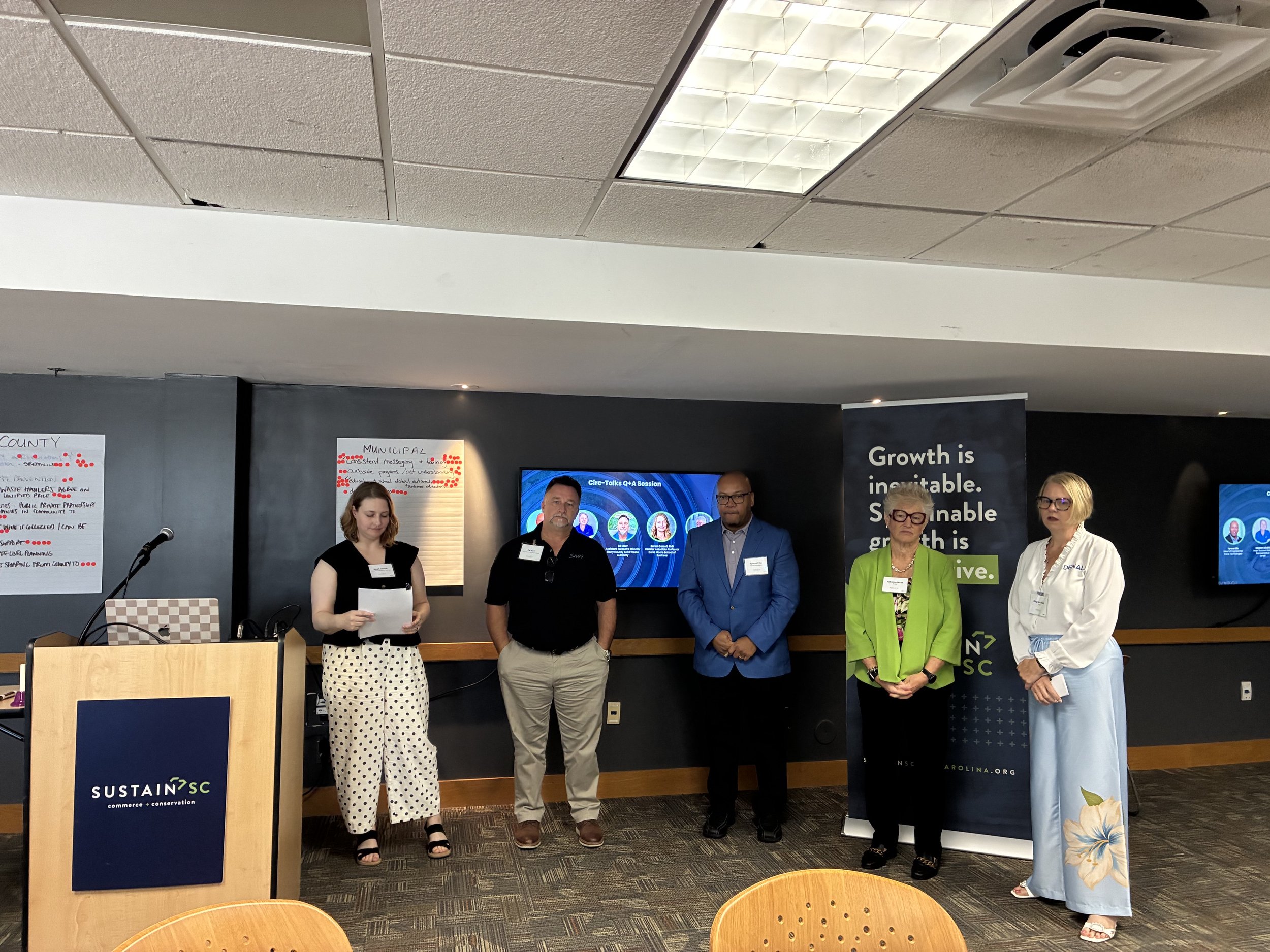
L to R: Sarah Carroll of the Darla Moore School of Business, Ed Marr of Horry County Solid Waste Authority, Tyrone Ellis of Trane Technologies, Rebecca West of Renewable Water Resources, and Meghan McGill of Denali.
Tyrone Ellis of Trane Technologies walked through six pillars of circularity, from material selection and circular design through reuse, remanufacturing and recycling. He uplifted the product design as a linchpin, noting fewer than 10 percent of products globally are designed with circularity in mind. Ellis identified remanufacturing, returning a used product to like-new condition through a controlled industrial process, as a specific economic opportunity for South Carolina and one where manufacturers here already operate.
Meghan McGill of Denali reframed food waste as recoverable value rather than disposal cost, describing de-packaging that routes unsold food into animal feed, compost and renewable energy through four South Carolina compost facilities. The scale is significant: organics accounted for 32.5 percent of disposed municipal solid waste, and 83.3 percent of that was food.
Rebecca West of Renewable Water Resources posed a question that reframed how the room thinks about a utility most people never consider: what if water never had waste in it? ReWa returns biosolids to more than 11,000 acres of private farmland, turns discarded oyster shell into reef habitat and treats every output as an input for something else.
Ed Marr of Horry County Solid Waste Authority returned to the operational side, describing how Horry County has made diversion an infrastructure strategy by investing in this composting capacity in addition to core sustainability operations like optical sorting at its materials recovery facility and expanding construction and demolition recycling.
Finally, Sarah Carroll of the Darla Moore School of Business shared insights from modeling Extended Producer Responsibility (EPR) exposure at the firm level, finding that costs concentrate in recycled-input requirements. For smaller firms, this carries a substantially higher burden relative to their own profit base — with direct implications for how any future policy is designed and phased.
Showing Up is Shaping South Carolina
As this session closed out, participants revisited the themes of the day: policy, collaboration and education. As a convener and a facilitator, Sustain SC will continue to create synergy and align mutual interest and perspectives.
The conversation will continue next month.
Our 5th Annual Sustainability Symposium on Oct. 22 in Columbia is where those threads come together — the one place each year where South Carolina examines how circularity, energy, water, land and growth intersect, and where a statewide conversation shapes the priorities that guide 2027 and beyond.
The state’s sustainability future is being built by the people who show up for it. We hope you will join us. Register here.