
Balancing the Load: Key Insights on Energy and Water Use with Data Centers in South Carolina
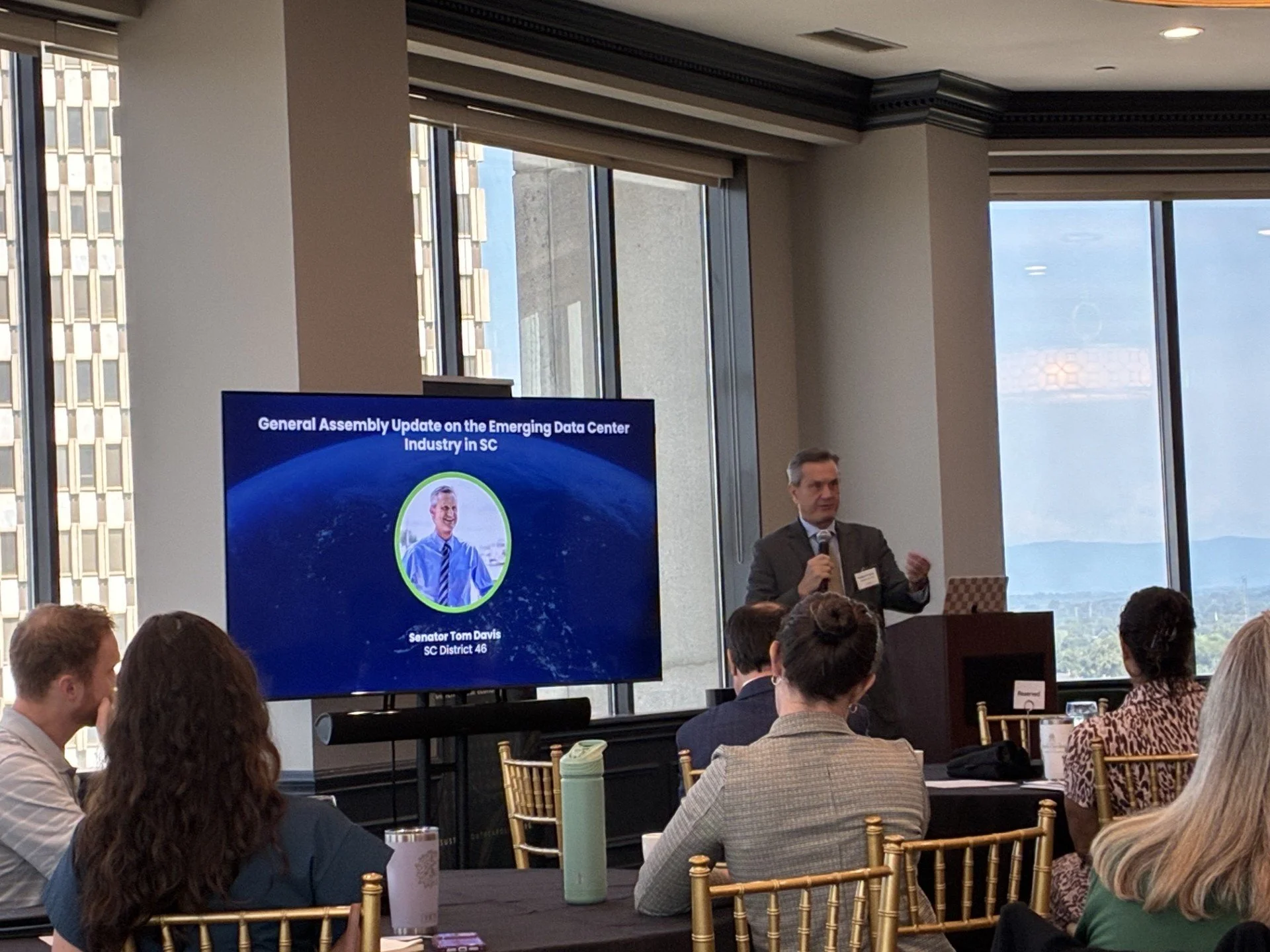
Senator Tom Davis, SC District 46 opened with an update on Statehouse conversations about South Carolina’s economic growth and data centers.
How does South Carolina meet rapidly growing electricity demand while managing water responsibly for large growth users, specifically the data center industry?
That question filled a room in Greenville on August 13. “Balancing the Load: Data Center Energy and Water Strategies,” the final workshop in Sustain SC’s 2026 energy and water series, reached capacity, drawing leaders from more than 40 organizations.
Members of both chambers of the General Assembly sat alongside county government, state agencies, electric and water utilities, data center operators, conservation organizations, manufacturers, economic developers and university researchers. The conversation was structured to increase mutual understanding of the challenges and opportunities related to data centers in South Carolina.
How the day was built
The two-day program began with a site tour of the DC Blox Data Center in Greenville, followed by a day of presentations and panel discussions about policies, economic incentives and data-driven operational impacts.
The program opened with a General Assembly update on policy conversations taking place at the Statehouse, followed by an overview to define what a data center is, and how facilities differ by scale, power draw and function. Then, utility and conservation presentations set the stage for multi-stakeholder panels. A cross-sector panel discussion explored how utilities balance long-term supply and demand through forecasting, as well as broader considerations around growth, energy and the use of natural resources.
After lunch, the focus shifted from energy to water, where panelists examined impacts related to supply and demand within South Carolina’s watersheds. A diverse panel discussed water stewardship and shared responsibility for the state’s natural resources. Conservation advocates, utility and data center executives took a deep dive on the rapidly evolving variety of data center cooling technologies and their impacts on water withdrawal and perceptions of data center water use.
The day concluded with a presentation of academic research identifying energy and water constraints resulting from increased system-wide demand driven by economic growth and aging infrastructure.
The day’s discussion uncovered the trade-offs associated with data center development: Closed-loop cooling uses substantially less water but more energy; Nuclear generation is reliable but slow to build; Solar must be paired with storage.
How Utilities Forecast and Plan for Growth and Demand
As one of the nation’s fastest growing states in the country, South Carolina electricity demand is projected to increase 33%-69% by 2045 with residential, commercial and industrial users sharing the load equally. That growth requires legislators and utilities to manage this increased demand, serving 6 million customers over the next 15 years. Load growth is driven not by any one industry, but by economic development, population growth and electrification.
This panel facilitated a rich discussion about how utilities will meet this demand.
Panelists walked through how forecasts are built: Resource planning considers the needs of the entire territory, considering not just customer demand growth, but also resource retirements and the planning reserve margin needed for catastrophic events like weather.
A large load customer is generally defined as a business using 50 megawatts or more. Academic research presented large load facilities drawing power at a near-constant rate rather than rising and falling with residential peaks. Modeled scenarios presented by USC Center for Sustainable Growth demonstrated how data centers could, under certain conditions, potentially help to improve system load factors, spreading fixed infrastructure costs across more consumption and reducing the cost of planned investment for residential ratepayers.
Utility representatives described how that potential is handled in practice. Large-load forecasts are deliberately discounted, with signed advanced development projects recognized at roughly 70 percent of projected load and earlier-stage pipeline projects above 50 megawatts at roughly 50 percent.
Conservation advocates pressed for greater transparency and guardrails, naming infrastructure cost responsibility, peak cost sharing and ratepayer protection as prerequisites. Furthermore, participants noted that new generation and transmission carry land and water consequences that should be discussed with conservation organizations at the beginning of a project.
From here, participants transitioned from the examination of energy impacts to water.
Presentations underscored that South Carolina’s watershed is also feeling the impacts of South Carolina’s growth. According to the research presented, water demand in other sectors (outside of power generation) could grow 50 to 95 percent, with agriculture accounting for roughly 35 percent. Conservation advocates underscored that like energy, stewarding this natural resource though improved collaboration in critical to moving forward in South Carolina.
Moving Forward
The question that we as a state are grappling with is how to accommodate this increased demand, and who is at the table when those decisions are made. In a diverse, cross-sector room, participants uplifted three imperatives to advance solutions to these roadblocks:
1. Accurate and transparent information is critical to build trust.
Cross-sector leaders emphasized the importance of making data center water and energy use public, underscoring that building public trust requires transparency from all sides. Data Center siting agreements, in the current state, begin with nondisclosure agreements and use code names, and, data center executives have been reluctant to share energy and water usage data, leading to understandable distrust and skepticism.
Communities and decision-makers need access to clear, project-specific information about proposed developments, including anticipated water and energy use, infrastructure needs and associated costs. Greater transparency around utility bills and projected resource demands, as well as limiting the use of nondisclosure agreements and project code names where possible, can help communities better understand what is being proposed and participate meaningfully in the conversation.
The South Carolina legislature’s recent budget reflects effort to gain the needed transparency. In this year’s budget, Proviso 55.28 establishes a new water-use reporting requirement for qualifying commercial data centers that consume three million or more gallons of water per month.
At the same time, the data informing those conversations needs to keep pace with a rapidly evolving industry. Some commonly cited information used to make policy decisions and shape community sentiment predates newer technologies, including closed-loop cooling systems that recirculate water and can reduce water consumption. As data center technology continues to evolve, legislators, local officials and communities need access to current, reliable information that allows them to evaluate potential impacts, benefits and tradeoffs and make informed decisions about future development.
2. Guardrails function as an important roadmap.
Conservation representatives pointed to consistent statewide rules as a starting point for credible community engagement. Academic analysis reached the same conclusion. Clear policy, infrastructure cost responsibility, peak cost sharing and ratepayer protection are needed to successfully meet the needs of South Carolina’s growing energy demands.
The current ambiguity around the industry carries a cost. It raises risks for utilities planning decades ahead, for developers evaluating sites, for local governments weighing proposals and for residents who live with the outcomes. Clear and consistent policies to guide cost sharing and the use of natural resources reduce these risks and create a more collaborative path forward.
Note, Sustain SC does not advocate for specific legislation, or specific policies.
3. Collaboration must start earlier.
One observation from the conservation community captured a pattern several participants recognized: conservation is typically engaged at the end of a project, when it needs to be involved at the beginning. Frameworks for balancing development within watersheds are improving, but they only function when the relevant parties are in the room before decisions are made.
The Balancing the Load Workshop demonstrated that utilities, conservation organizations and the state’s natural resource agencies convening alongside operators, developers and legislators is critical as data centers become increasingly prevalent.
What Comes Next
Sustain SC will continue to help facilitate this critical conversation. We are pleased to announce a partnership with the Public Policy Institute (PPI) at Charleston School of Law, pairing a team of PPI Student Research Fellows with Sustain SC this fall to examine how South Carolina can responsibly prepare for continued growth in energy-intensive industrial development like data centers. The purpose of this project is not to advocate for specific policies, but rather to help local governments and decision makers make informed choices.
This conversation will also continue at our fifth Annual Sustainability Symposium in Columbia on October 22 with a panel discussion titled, Managing the Load: Balancing Data Center Industry Expansion and Our Natural Resources in South Carolina. Grab your ticket and join us for the next conversation!
Thanks to our Energy and Water Workshop Sponsors who made this session possible.
Gold | DC Blox and ReWa
Silver | Columbia Water, Parker Poe, PHENOGY, Milo's Tea and RWE